At a Glance: The Best Briefcase for a Lawyer
![Professional man in a grey suit carrying a tan Italian leather briefcase.]()
A structured full-grain leather briefcase in black or brown, sized to fit your laptop alongside legal-size files, with no visible logo. That's what the majority of lawyers we sell to end up carrying.
We build a full range of briefcases for legal work. The right one suits your practice and what you carry on your heaviest days. Buy it for that load, not for the lightest day.
-
Heavy file load every day (litigation, trial prep): The Von Baer No.1 Leather Briefcase, the most organised in the range. Three gusseted compartments, key-lock closure, and a padded 16-inch laptop compartment.
-
Mostly a laptop and a few files: The Von Baer Elegant Briefcase is the lightest in the range, built for a 14-inch laptop, a notebook, and a few documents. If you carry a 16-inch laptop, the Von Baer Essential Briefcase has a padded sleeve sized to fit a 16-inch MacBook Pro.
-
Carrying a 17-inch laptop: The Von Baer City Large Laptop Bag is the only bag in the range that fits a 17-inch laptop in a dedicated padded centre compartment.
-
Confidential client files in transit: The Von Baer No.1 Leather Briefcase has key-lock closure. If you carry less, the Von Baer Diplomat Briefcase pairs a single key-lock with a smaller, slimmer case.
-
Frequent court, client, and airport travel: Every Von Baer briefcase includes a luggage strap and meets most airline personal item requirements. Check your carrier's specifics, but you shouldn't need to check the briefcase.
-
Moving between firm office, client site, and courtroom all day: The Von Baer Diplomat Briefcase's detachable shoulder strap leaves your hands free when you're on the move. Carry it crossbody between sites, set it down as a briefcase in the room.
-
Women lawyers: The same legal-work criteria, with fit and proportion adjusted.
What to Look for in a Briefcase for Legal Work
![Professional man in a suit signing a document next to a brown leather briefcase on a glass table.]()
Capacity, structure, leather, closure, and restrained styling decide whether a briefcase works for daily legal practice.
-
Capacity: Buy the briefcase for your heaviest day, not your average one. A litigator hauling a redweld and two binders to a hearing lives a different week from in-house counsel carrying a laptop and a notepad - and the same lawyer needs more room in trial weeks than in quiet ones. You need a case that fits everything from your busiest days without bulging, because a bag straining at the seams looks disorganised from across the room. There's a full day-by-day breakdown in our guide to what lawyers actually carry.
-
Structure: A structured case stands upright when you set it down and keeps its shape with a full load inside. That comes from the build, not the leather alone: reinforced panels, a structured base, and protective metal feet that keep the leather off wet pavement and courtroom floors. A soft, unstructured bag saves a little weight and loses the formality - and once it starts sagging, it never quite recovers.
-
Leather: Full-grain, and nothing less. It's the strongest grade, it keeps its refined look through years of daily use, and it's the difference between a briefcase that keeps its looks and one that peels at the stitched edges within a year or two. The grades below it - top-grain, "genuine", bonded - are corrected or reconstituted hides, sanded, refinished, or pressed back together from scraps, and they show it first at the corners and handles, the places a work bag wears fastest. We cover the grades in detail further down.
-
Closure: The closure has to stay shut. A flap or zip that comes open in the back of a taxi or on the floor beside you in court is the kind of thing you only let happen once - especially when the files inside belong to a client. Our zips use precision brass teeth set into high-grade woven tape, with a denser, closer tooth arrangement than a standard metal zip. We have them independently tested by accredited third-party laboratories for corrosion resistance and metal safety, and in manufacturer testing, lateral strength reached 650N against the 250N standard minimum for #5 zips and 750N against the 470N standard for #8.
-
Restrained styling: No visible logo, no seasonal design. Black or brown. The briefcase that works in every room you walk into is the one that never stands out in any of them. High-priced luxury products tend to carry less prominent logos, according to the International Journal of Advanced Research in Management and Social Sciences, and houses built on understatement keep growing: Brunello Cucinelli posted 12.2% sales growth in 2024. Brands that lead with their logo still pull higher search demand, but we'd rather be chosen for the leather and the construction.
We design every Von Baer briefcase for that working week, not for a photoshoot. A properly made full-grain leather briefcase lasts years of daily use, so you buy it once. We never put our briefcases on sale, and we never overprice them. The price reflects the materials and the construction, not a markup waiting to be discounted.
- A ResearchGate analysis of the luxury resale sector puts the pre-owned luxury market at roughly US$37.4 billion in 2024, with projections reaching US$68 to US$79 billion by 2028 to 2032. When a bag is built well enough to sell on, it stops being an expense and starts holding its value.
- We sell directly to our customers, without wholesalers, retailers, or agents and their markups. The business is entirely self-funded, which means the decisions we make are for the long term, not driven by outside pressure to cut corners.
- We back every briefcase with a 5-year warranty covering defects in materials or workmanship under normal use.
- Every Von Baer briefcase ships with complimentary blind-embossed personalisation: up to four initials, hand-pressed with heated brass type onto the leather luggage tag. We include personalisation as standard so what's visible on the tag is your name, not ours.
You can compare every model in the full leather briefcase range.
Leather and Other Briefcase Materials
![Open brown leather briefcase showing a slim laptop inside the main compartment.]()
Full-grain leather is the default for a lawyer's briefcase because it does two things at once: it holds its structure under a heavy daily load, and it stays distinguished with age rather than cracking and peeling the way cheaper grades do.
Not all leather is the same. Full-grain uses the complete outer surface of the hide with the natural grain preserved in full. It is the strongest, most durable grade. Top-grain and "genuine" leather are lower grades, sanded and corrected to hide surface damage. They don't last as long and they don't age as well.
Nylon and canvas briefcases weigh less and often cost less. Some lawyers prefer them for the weight saving, especially on a long commute by foot or public transport. But they present less formally than leather in a courtroom or a client meeting, and they wear through sooner under the same daily use.
Reading leather quality is simpler than the marketing makes it sound. There's more in our guide to briefcase materials. Grade, cut, and dye:
-
Grade and selection: We select A-grade hides from Bos Taurus cattle only, the top selection grade, chosen for tight, fine, consistent grain. Hides with excessive bites, scars, or surface damage don't make the selection. A-grade costs significantly more, and it's why the grain looks clean and even across the whole briefcase.
-
Cut: Our leather is cut from the bend, the back and butt of the hide, where the fibres are densest and tightest. Belly and shoulder leather is weaker and more stretch-prone, and many manufacturers quietly save money by using it.
-
Dye: Drum-dyed leather has colour that runs all the way through the hide. Look at the cut edge: if the colour goes through, it's drum-dyed. A scuff on surface-dyed leather fades pale. A scuff on drum-dyed leather shows the same colour underneath, which matters when your briefcase takes daily wear.
Refined case leather is about 1.4 to 1.8 mm, enough for the leather to hold a clean silhouette and shape a comfortable handle without bulking up. Very thick leather (2.5 to 3 mm) belongs to saddlery and workwear: stiff, heavy, and impossible to shape into a handle anyone wants to carry all day.
Every briefcase in our range carries Cuoio Superiore certification. Each leather batch is laboratory-tested, and the tannery itself is audited on-site at least every three years. That certification is the one quality claim you can verify instead of trusting the seller's word.
We call this approach Fundamental Luxury. Fundamental Luxury is the belief that luxury must begin with the product itself. A high price may be justified - but only by exceptional materials, intelligent construction, functional design, skilled workmanship, and lasting value. It combines the symbolic value of luxury with the fundamental value of an exceptional product.
- The lining matters too, and it's judged by grade, not by fibre name. Our briefcases are lined with high-grade cotton twill, a durable natural lining that is easier to clean than suede or exposed leather.
- We build the lining as a separate crafted component, with its own pattern-making, fit, and stitching. It takes more work than simply exposing the reverse of the leather or covering the inside with suede.
- If a bottle leaks inside a suede-lined briefcase, the suede soaks it up and the stain is permanent. A proper lining gives you the chance to clean it before it reaches the leather.
Condition the leather two or three times a year, depending on how often you carry it. That's all it needs.
Types of Briefcases Lawyers Carry
![Woman pulling a brown leather carry-on suitcase and matching laptop bag in an airport terminal.]()
A structured briefcase presents most formally. Softer forms, messengers, and totes trade formality for less weight. Where you spend your working day and how much you carry there decides the form.
-
Structured briefcase or attaché: The traditional form for legal work. Rigid sides, a defined shape, and it stands upright on its own. This is the briefcase that holds its shape in a courtroom, a partner's office, and a client meeting, whether it's full or half-empty.
-
Soft leather briefcase: Less rigid and lighter to carry. Better suited to lawyers whose daily load is a laptop and a few files, and whose commute involves a lot of walking or public transport.
-
Messenger: A crossbody strap keeps your hands free. The trade-off is formality: a messenger looks less traditional in a courtroom than a structured briefcase. For lawyers moving between sites all day, though, it's the most practical form to carry.
-
Professional tote: Popular with women lawyers. A structured leather tote holds a laptop and files in a form that suits a professional wardrobe without the bulk of a traditional briefcase.
-
Rolling briefcase: Useful for litigation lawyers carrying heavy file loads through airports and courthouse corridors. Our briefcases aren't wheeled, but every model includes a luggage strap so the briefcase slides onto a rolling suitcase's handle when you travel.
The DOT Air Travel Consumer Report for December 2025 puts US baggage mishandling at roughly 5.16 per 1,000 passengers. Most bags arrive, but the one carrying your laptop and case files is the one worth keeping on you.
In the UK, "barrister brief bag" refers to the structured leather case used in chambers and court. It's the same form as the structured briefcase, sized for briefs and legal papers.
Best Briefcases for Litigators and Trial Work
![]()
Litigators need the most capacity of any lawyer. Your briefcase has to hold redwelds, binders, legal pads, and a laptop in separate organised sections, and it has to do that every day without the seams or handles giving out under the weight.
A triple-gusset design (three deep compartments side by side) is the standard for this kind of load. We built the Von Baer No.1 Leather Briefcase for the partner walking into chambers with case files and a 16-inch laptop. It has:
- three gusseted compartments that hold A4 documents without folding
- a padded 16-inch laptop compartment
- slip pockets for a phone and tablet
- pen slots
- a zipped back pocket for quick access at security or the courthouse door
A full-leather briefcase in this class weighs roughly 1.1 to 1.8 kg empty. That's not heavy. The files and the laptop make up the real weight, and what matters is whether the briefcase distributes that load through reinforced construction or concentrates it on a few stitches and a single leather layer.
We build each handle and strap attachment as a load-bearing component: layered leather, thinned at the joins to control bulk, reinforced inside with tear-resistant material, so the stress spreads through the structure rather than pulling through at the anchor. Without it, a handle under daily litigation weight tears the leather or pulls the stitching through within a year or two.
- We use a water-based glue with no solvents, because solvent-based adhesives damage leather over time.
- The needles are in three point types matched to the leather thickness at each join.
- The thread is Serafil by the Amann Group in three weights, the heaviest reserved for fabric sections and blind seams.
- And the edge coat is the Fenice system, applied in three stages, so the edge stays flexible and resists cracking where a single-coat paint fails.
If your heaviest days take you from court to the airport, the luggage strap on every Von Baer briefcase lets you slide it onto a rolling suitcase through the terminal.
You can compare our litigator briefcases and attorney briefcases to find the right model.
Best Briefcases for Women Attorneys
![]()
The criteria are the same as for any lawyer. What changes is proportion and how the briefcase fits a professional women's wardrobe.
- A structured leather tote that holds your laptop and a day's files is the most popular choice we see among women lawyers. It carries the same load as a traditional briefcase, rests comfortably on the shoulder, and looks right with business dress. We have covered the full options in our guide to work bags for female lawyers.
- The other option is a women's-cut briefcase: the same structured form, scaled in proportion and often lighter.
Both carry a laptop. Both hold legal-size files. And both should be available with a lock if you carry confidential client documents. Women lawyers ask us for locked briefcases just as often as their male colleagues, because the professional duty behind it is exactly the same.
The difference between the two is usually how you carry it. A tote hangs from the shoulder and keeps your hands free. A structured briefcase is carried by the handle and presents more traditionally in court. Lawyers who move between a car, a courthouse, and a firm office often prefer the tote. Lawyers who present in formal settings all day tend towards the structured briefcase.
Locking Briefcases and Client Confidentiality
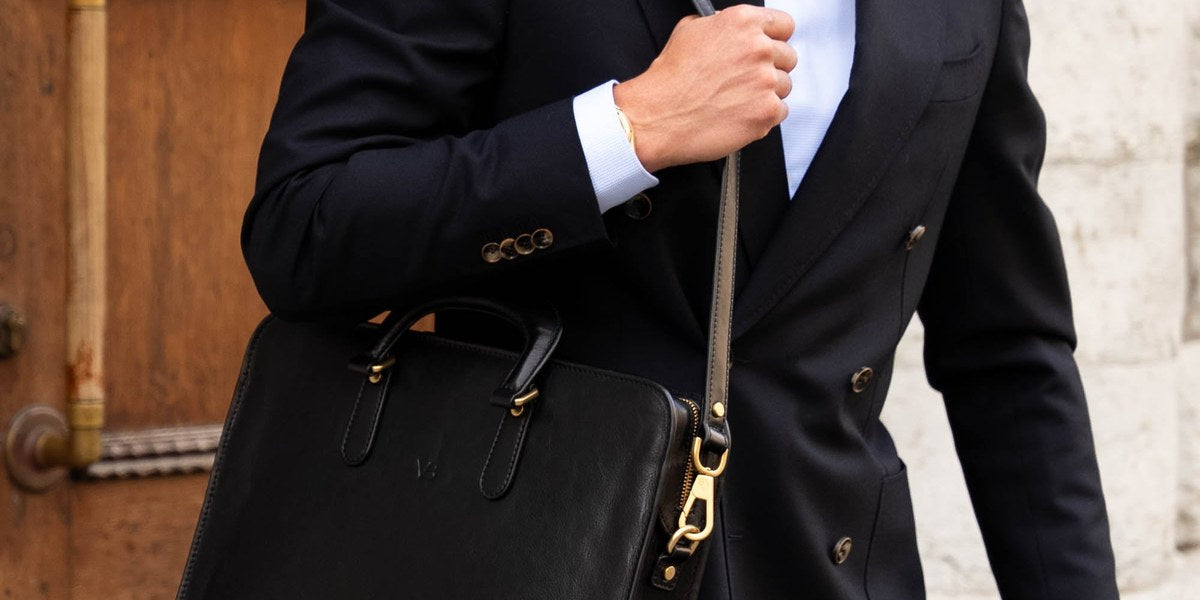
![Man in a suit holding a structured black leather briefcase with gold hardware.]()
A lock on a briefcase matters wherever the briefcase carries confidential client files, and in legal practice that is most of the time.
This is about professional duty, not theft. Client files left in a taxi, an airport lounge, or a courthouse corridor are exposed to whoever picks the briefcase up. A lock turns a lost briefcase into a delayed inconvenience rather than a confidentiality breach.
The lock itself has to work, not just look the part. The Von Baer No.1 Leather Briefcase has key-lock closure; the Von Baer Diplomat Briefcase carries a single key-lock on a smaller, slimmer case. We've sold over 5,000 locked briefcases in the last ten years, with fewer than 0.1% recorded lock failures, and the rare failure typically came around the seven-year mark from loads well beyond normal use.
Every piece of hardware passes four separate checks by four different teams before it reaches a finished bag:
- the craftsperson signs off their own work
- a quality-control team inspects it
- it is checked again at mounting
- an independent final inspection clears the product
Representative samples then undergo salt-spray corrosion testing, heat and humidity ageing, and repeated cycling to failure.
Even on a briefcase without a key lock, the closure should not come open under a full load. A zip-top that stays shut or a flap that lies flat keeps your files out of sight and stops anything from sliding out. A closure that springs open the moment the briefcase is full isn't a minor annoyance when the contents are client files.
Browse our locking briefcases.
FAQs
![Man in a suit carrying a large brown full-grain leather garment bag on a city sidewalk.]()
Do lawyers still use briefcases?
Yes, lawyers still use briefcases. The structured leather briefcase is still the traditional professional choice in courtrooms and client meetings. Totes, messengers, and backpacks are widely accepted now, especially in less formal practice areas, but the briefcase remains the default where formality matters. We have answered that question in full here.
What kind of briefcase do lawyers use?
Most lawyers carry a structured full-grain leather briefcase that holds a laptop and legal-size files, in black or brown with no visible branding. Litigators tend towards larger multi-section briefcases with room for binders and redwelds. Many women lawyers carry structured leather totes that hold the same load in a different form.
Do leather briefcases last?
A quality full-grain leather briefcase lasts many years of daily use with occasional conditioning. Full-grain holds its condition because the surface grain is intact and the fibre structure is at its strongest. Bonded leather and "genuine" leather are the grades that fail early: the layers peel, the stitching loosens, and the hardware gives out, often within a year or two.





Your email address will not be published.