Your Bag Says More About You Than You Think - What’s Yours Communicating?
A sharp suit, polished shoes, and an elegant watch - all subtle markers of success.
But when it’s time to travel, what’s slung over your shoulder? A well-chosen leather duffel signals taste, discernment, and an appreciation for quality. The wrong choice, however, can suggest the opposite.
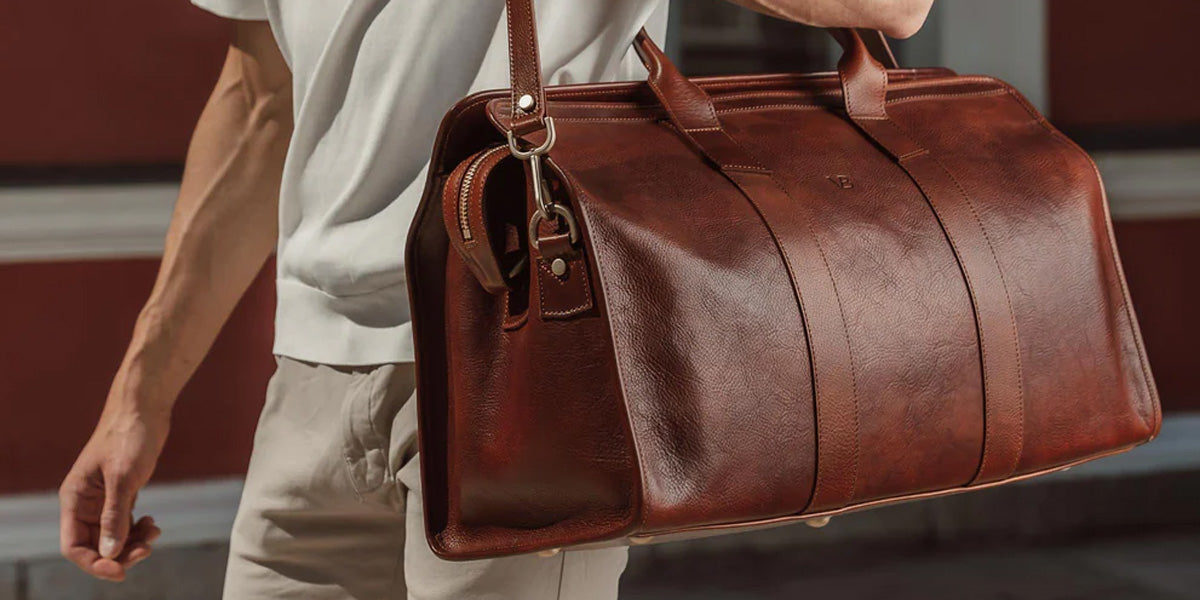
Walking into a luxury hotel, imagine yourself cring as you hand over a scuffed, synthetic bag with plastic zips. Compare that to handing over a buttery-soft, full-grain leather duffel from Von Baer that’s been broken in over time, rich in character and craftsmanship. One gets tossed onto a luggage cart. The other earns a knowing nod from the concierge, and fills you with a sense of price and confidence.
This is more than just aesthetics - a quality leather bag streamlines travel. Cheap luggage tends to fail at the worst possible moments: low-quality zips (below #8 gauge) split under stress, weak stitching (fewer than six stitches per inch) comes apart, synthetic handles snap under a 30-lb load. A properly constructed duffel becomes a trusted companion - one that works with you, not against you.
Travel isn’t just about where you’re going - it’s about how you arrive.
Ever wondered which duffel bag Alan Ritchson aka Reacher uses? It's a Von Baer Grand - here's the video:
Why the Right Leather Matters More Than Anything Else
Not all leather is created equal, and in the world of travel bags, the material defines everything - durability, aesthetics, even the way the bag ages.
Here’s the breakdown:
-
Full-Grain Leather - The gold standard. Naturally tough, it develops a deep patina over time, making each bag uniquely yours. Every scratch and crease tells a story. Expect a thickness of 1.4mm to 2.2mm, which ensures durability while keeping the bag lightweight.
-
Top-Grain Leather - A slightly sanded version of full-grain. Smoother but sacrifices some strength and character. It’s the “polished” look but won’t age as naturally. Generally 1.2mm to 1.6mm thick.
-
Genuine Leather - A marketing term that sounds premium but isn’t. It refers to lower-quality leather scraps bonded together. Peels, cracks, and won’t last. Thickness is typically under 1mm, making it far less durable.
-
Bonded or PU Leather - Faux leather mixed with plastic. Avoid it entirely. If it has a "leathery" smell but feels too smooth or plasticky, it’s likely synthetic.
Tanning Process:
-
Vegetable-tanned leather (using natural tannins from tree bark) absorbs oils and moisture, allowing a deep patina to develop over 5–10 years.
-
Chrome-tanned leather (mass-produced with chemicals) may retain a uniform colour longer, but it’s prone to drying out and cracking.
That's why here at Von Baer we use the best A-grade full-grain leather for our products - you will see and feel the difference (learn more).
How to Spot True Full-Grain Leather (Without Relying on Labels)
Even premium brands sometimes cut corners, so don’t just take the label’s word for it. Here’s how to test the quality yourself:
-
Texture Test: Full-grain leather has a distinct, slightly uneven grain pattern. If it looks too perfect, it’s likely top-grain or lower.
-
Nail Press Test: Press your fingernail into the surface. Real full-grain will show a temporary indentation - proof of its natural fibres.
-
Water Absorption Test: A small drop of water should darken the surface momentarily before being absorbed. If it beads up, it’s likely plastic-coated.
A former colleague bought a "genuine leather" duffel on impulse during a business trip in Rome. At first, it seemed luxurious - smooth texture, rich colour. Within months, the coating began peeling at the corners, revealing rough, uneven fibres underneath. By year’s end, the edges had cracked, and the straps frayed so badly they had to be reinforced with duct tape before a flight. Eventually, he admitted what he’d been avoiding: he’d spent hundreds on a bag that wasn’t built to last. If he had paid attention to the grain pattern and done a simple water test at the shop, he would have spotted the difference. Instead, he learned the hard way.
Picture your bag a decade from now. A full-grain duffel will look better, feel softer, and tell a richer story. A cheap alternative? It won’t even make it that far.
Check out our full leather guide here.
How to Tell If a Bag Is Built to Last - Without Learning the Hard Way
A high-end bag should age like a luxury car - better with time. But how do you spot one that’s built to go the distance?
-
Stitching: Look for hand-stitched or reinforced double stitching. Loose or uneven seams mean short-lived durability. French seams or tight, even lockstitching back-tacked at stress points are ideal - strong, clean, and unlikely to unravel. Opt for at least six stitches per inch (SPI); anything under four SPI is too loose and will fray over time.
-
Zips & Hardware: brass zips glide smoothly and won’t snag. Plastic? A dealbreaker. A quality bag uses at least #8 to #10 gauge metal zips, ensuring resistance to pulling forces over 22.7 kg (50 lbs).
-
Lining: Cheap bags cut corners inside. Suede, durable canvas, or high-grade cotton (285-340 g (10-12 oz) weight) keep contents safe while resisting wear. Avoid polyester - it rips easily.
-
Handles & Straps: Full-leather or reinforced handles prevent early fraying. Bonus if removable shoulder straps are included for versatility. Check metal clasps - weak ones snap under pressure over 11.3 kg (25 lbs).
Want more duffels? See this range.
On a red-eye from New York to London, a well-dressed passenger in business class had a striking leather duffel tucked under his seat. The leather had that unmistakable lived-in richness, but what caught attention was the solid brass hardware - thick, weighty, aged beautifully. In contrast, another traveller’s sleek but flimsy “designer” bag lost a strap mid-boarding, leaving him fumbling to sling it over his shoulder awkwardly. The stitching had failed near the handle, likely from poor construction or overloading. He tried to hide his frustration, but you could see it - a bag should never make travel harder.
If a bag’s details feel cheap, so will your experience using it.
See all men's travel bags here.
Why a Premium Duffel Is a Long Term Investment
A cheap bag is an expense that needs replacing. A premium duffel is a long-term asset.
-
Lifetime Value: A well-made bag lasts 15+ years with proper care.
-
Breaks in, Not Down: Full-grain leather becomes more supple and rich with time, unlike cheaper options that crack and flake.
-
Effortless Ownership: No need to baby it - quality leather handles wear beautifully.
A well-chosen duffel isn't just another travel accessory. It’s a trusted companion that ages with you, improving every step of the way.
Want to carry a suit? You need a garment duffel bag (browse them here).
The best travel experiences deserve a bag that’s built to match - choose Von Baer today.







Your email address will not be published.