
Business Travel Carry Solutions: How to Choose and Pack Your Bags

A jacket packed flat into a stuffed roller arrives with a fold line down the lapel, an hour before your pitch.
A carry-on that clears the sizer in New York goes on the scale at the gate in Frankfurt, so you check it and lose thirty minutes at baggage claim, which is what you were trying to skip.
Both come from treating business travel as a one-bag decision when it's really a small system: two bags, chosen around how many nights you're away, what your airline actually enforces, and how put-together you need to look when you walk in.
- Travel with two bags: one main bag for clothes, one personal item for your laptop and the things you'll want in the seat.
- One to three nights is carry-on-only territory. Past that you're into a larger carry-on or a checked bag.
- Check size and weight separately. A common US carry-on limit is 22 x 14 x 9 in (56 x 36 x 23 cm), and many international and low-cost carriers cap the weight too, often around 7-10 kg (15-22 lb).
- To pack a suit, hang it so it curves gently instead of folding it flat. Folding it flat sets a crease in the wool. Hanging it on a curve doesn't, so you can wear the suit when you land.
- Buy for durability where bags actually give out: the zipper and the hardware, plus a real way to get the bag repaired. How heavy a bag is and how many pockets it has don't predict how long it lasts.
How many bags do you need for a business trip?
For most business trips you need two bags: one main bag for clothes, and one personal item that holds your laptop and whatever you want in the seat.
The main bag goes in the overhead bin or gets checked.
The personal item goes under the seat in front of you, so your laptop, charger, passport and headphones stay in reach without opening the big one.
Can you do the whole trip carry-on only?
One to three nights, and you can do the whole trip carry-on only. That's a couple of shirts, one spare set of clothes, a suit if you need it, and a toiletry bag.
Build the habit if you can. You skip baggage claim, you can't be separated from your bag on a tight connection, and you move at your own pace.
It costs you a little discipline:
- You re-wear a jacket.
- You rinse a shirt in the sink.
- You pour toiletries into travel bottles.
Past three or four nights, or when you're taking a suit plus separate shoes plus gym clothes, you either size up to a larger carry-on or accept a checked bag.
Force five days into a two-day bag and you arrive with everything wrinkled.
If you're not sure what counts as your personal item versus your carry-on, we cover the difference here.
Roller, duffel, or backpack: which main bag?
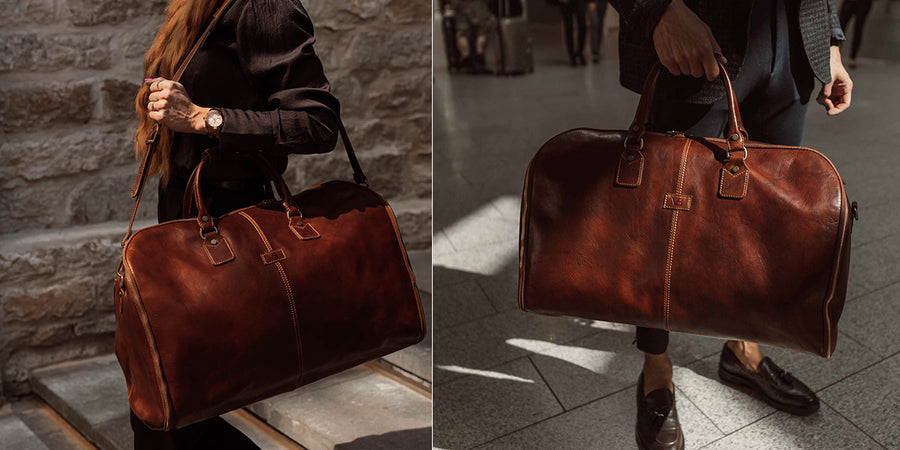
Image: Grand Leather Garment Bag
You have three choices for a main bag: a wheeled roller, a soft duffel you carry on your shoulder, or a backpack.
- Take the roller for long airport walks and a generous weight allowance.
- Take the duffel when you're not walking far and you want something light that still looks good.
- Take the backpack for hands-free comfort over distance, when you don't need to look formal walking in.
A roller takes the load off your shoulder, which is why it's the default choice if you fly often.
But the wheels and a telescoping handle add roughly 1.5-2 kg (3-4 lb) of empty weight, plus two more things that can break: the wheel axles and the handle, which are the parts that give out first.
A soft duffel has less hardware on it, so it weighs less and there's less to fail.
Carry it through a long terminal when it's packed, though, and your shoulder starts to ache after a couple of hours, so you end up swapping sides.
A backpack spreads the weight and frees your hands for a coffee and a boarding pass. It just looks more casual walking into a client meeting.
| Bag type | What it costs you | Best when |
|---|---|---|
| Wheeled roller | 1.5-2 kg (3-4 lb) of empty weight, plus wheels and a handle that can break | Long airport walks and a generous weight allowance |
| Soft duffel | A shoulder that aches after a couple of hours | You're not walking far and you want something light that still looks good |
| Backpack | Looks more casual in a boardroom | Hands-free comfort over distance |
Which one wins when the airline weighs your bag?
A roller's wheels and handle are 1.5-2 kg (3-4 lb) of your allowance, gone before you pack a thing.
So on an airline that weighs your carry-on, a lighter duffel you carry can beat a heavy roller.
On a generous US-domestic ticket the wheels usually win.
On an 8 kg (18 lb) limit, that empty weight can get the bag gate-checked anyway, which is what you bought it to avoid.
How the bag looks when you set it down
If you need the main bag to look right walking into a client's office and to still look right in three years, the material and the build matter as much as the wheels.
A full-grain leather duffel develops a patina as it ages, while a hard-shell roller just collects scratches. It also holds its shape when it's full and you set it down.
That's why a leather holdall like our Weekender suits shorter trips, and you can browse the leather holdall collection here.
How do you keep a suit from arriving creased?

The way to keep a suit wearable is to hang it so it curves gently, instead of folding it flat.
Fold wool hard and you bend the fibers past the point where they spring back, which sets a crease that hanging the jacket in a steamy bathroom won't fully lift.
Hang the same jacket so it bends around a wide curve instead of a sharp fold, and the fibers never pass the point where they spring back, so the jacket relaxes flat again when you hang it at the other end.
What each way of packing a suit costs you
You're trading space for protection:
- Rolling works for knit tops and casual clothes and resists hard creases, but it won't protect a structured jacket.
- Packing cubes keep everything tidy and buy you space, though a jacket is the one thing to keep out of a compression cube.
- A full-length garment bag holds a suit best of all, but it's usually too long for an overhead bin and often counts as your second bag.
- A slim tri-fold garment bag packs a suit into thirds, so it creases along those folds.
Which bag gets a suit into one carry-on?
For carry-on travel, a garment duffel is the answer.
It opens out flat, the suit hangs on a clip-in hanger inside a garment holder built into the lining, and when you zip it back into a duffel the suit curves around the inside instead of folding.
The suit only holds that gentle bend if there's space around it, so pack the rest of your clothes in and stop before you force the compartment full.
That's how our Grand holds a suit and a couple of days of clothes in one carry-on, with no hard fold in the suit.
If you need to bring a suit and still travel carry-on, see our garment duffels here.
The bag for your laptop, documents and tech
Your personal item is the bag you actually work out of, and what you want from it is fast, safe access to your laptop.
In the US you'll usually take the laptop out at security, so you want a padded sleeve you can reach without unpacking the whole bag, ideally one that opens from the back or the top so it isn't buried under your chargers.
That padded sleeve saves you from kneeling at security, digging a laptop out from under a tangle of cables while the line backs up behind you.
You also want:
- A slot for a passport and a couple of documents.
- A pocket for cables.
- A case that stands up on its own when you set it down.
Briefcase, backpack, or slim laptop bag?
- A briefcase looks the most formal, stays upright when you set it down in a meeting, and the better ones lock, which matters if you carry confidential files.
- A backpack is the most comfortable over distance and keeps your hands free, at the cost of looking less formal in a boardroom.
- A slim laptop bag is the lightest and the least fuss if you're carrying a laptop and little else.
The padded sleeve is what protects the laptop, so a heavier case with the same sleeve protects it no better.
We compare travel briefcases in detail here.
How do you pack it to fit and move fast?
- Keep the jacket out of any compression cube. Compression sets the exact crease you're trying to avoid.
- Put cables, a charger and adapters in one pouch. Then you're not untangling them at the security tray.
- Keep any power bank in your carry-on, never in a checked bag. Spare lithium batteries aren't allowed in checked luggage, and a checked bag with one in it gets pulled.
- Pour liquids into travel bottles at home. Your quart bag is ready before you reach security.
- Put your boarding pass and passport in a zippered pocket, not an open one. In an open pocket a passport works loose when the bag tips in a bin, and a document you can't find at the gate is a delay you don't need.
- Wear the jacket and your heaviest shoes onto the plane. That keeps them out of the bag entirely, which is weight and bulk you never have to plan around.
Will your bag fit the carry-on size and weight limits?

The mistake here is checking size and forgetting weight. They're two separate limits, and you can pass one and fail the other.
Size is the one everyone knows: a common US carry-on maximum is 22 x 14 x 9 in (56 x 36 x 23 cm).
And your personal item needs to fit under the seat, often around 17 x 10 x 9 in (43 x 25 x 23 cm).
Weight, on the carriers that enforce it
Many US carriers publish that size limit and rarely put an economy carry-on on the scale.
Fly internationally or on a low-cost carrier, though, and weight becomes a hard limit of its own.
Lufthansa, for one, caps a carry-on at 8 kg (18 lb), and 7-10 kg (15-22 lb) is common across strict carriers.
The bag's empty weight comes out of the same allowance as everything you pack, so a heavy roller on an 8 kg (18 lb) limit leaves you little room before you're over.
Two features that can cost you the fit

Image: 10X Leather Laptop Travel Bag
An expandable bag can fit the sizer when it's zipped shut and stop fitting the moment you expand it.
And a four-wheel spinner, as nice as it is on smooth terminal floors, has less room inside because of the wheel wells, and it will roll away from you on a sloped jet bridge.
None of this means buy the smallest bag. Buy a bag that comes in under the smallest limit on each measurement across the routes you fly regularly.
No single airline is the strict one on all three: carriers that are tighter on length are often looser on width.
We cover American Airlines' exact carry-on rules here.
The mistakes to avoid
- Buying for your average trip. The bag that's fine for an overnighter is the one you end up forcing five days into, and that's how everything arrives wrinkled.
- Over-packing. It strains the zipper and leaves you nothing in reserve.
- Trusting the wrong signals for quality. A heavy bag feels solid, but weight tells you nothing about how long it lasts. More pockets add more parts that can break. And a bigger bag isn't better if it can't stay inside the weight limit.
One thing you can stop worrying about: picking a color other people don't have only helps you spot your bag at baggage claim, and with a carry-on you never go there.
How do you tell whether a bag will last?

Look at the zipper and the hardware, and at whether the brand will repair them.
On almost every bag the leather or the shell outlives everything else. The zipper gives out first, then the wheels, then the handle.
So being able to get the bag repaired matters as much as the build, and a bag whose zipper can be replaced lasts longer than an identical one you'd have to throw out when the zipper fails.
Getting the bag repaired can mean the brand takes it back to fix it, or simply that a leather repair shop can restitch a seam and swap the zipper. A sealed, glued-shut bag gives you neither.
Buying once tends to cost less over the years than buying a new one every year or two, as long as the hardware holds up and you can get the bag repaired.
So check the warranty before you buy: ours is a 5-Year Limited Warranty, and you can read the terms here.
We strive for the highest editorial standards, and to only publish accurate information on our website.






Leave a Comment
Your email address will not be published.