
How to Travel to a Client Pitch Meeting

The pitch itself you can handle. What's left is a 7 a.m. flight and a suit that has to look right in a stranger's boardroom four hours later.
Work through these the day before you fly:
- When to travel.
- How to pack the suit.
- What to carry it in.
- How to arrive with time to spare.
Should you travel the day before or the same day?

Travel the day before whenever the pitch is more than a short hop away, or early enough that a delayed flight would wreck it.
A same-day trip is fine for a morning drive, or for a nearby city with a mid-afternoon meeting time (and a real backup plan). Past about two hours of travel, book the extra night.
Go the evening before and you can have a leg canceled and still get there, your body clock catches up by morning, and the suit hangs all night. You get none of that on a 6 a.m. flight.
Traveling the same day saves you a hotel and an evening away from home. But it leaves you no slack, so one backed-up highway or one holding pattern is enough to make you late.
If it has to be same-day, book the earliest sensible departure, so there's still time to get there after a delay. A flight that lands 45 minutes before you're due at the client's front desk leaves you no room at all.
What to confirm before you leave for the pitch

Before you leave, confirm how you actually get into the client's building. A map won't tell you that.
A big company's front desk often works from a visitor list that gets set the day before, and at 8:55 they won't let you up if your name isn't on it.
Settle these three from your own desk:
- Access. Call whoever booked the meeting. Ask if you need to be pre-cleared, and get the name of who to ask for at the desk.
- The time. Send a short email a day or two out to reconfirm it. You lock in the time, and you find out about a moved room or a changed floor while you can still adjust for it.
- The last stretch. Leave real slack for it. A client's lobby security line can take longer than you've planned for.
Can you pack a suit in your carry-on bag so it arrives uncreased?
It is possible, but risky, and can introduce hard fold lines that don't fall out before your big pitch.
Fold wool tight across a sharp edge and the fibers bend past the point where they spring back, so that crease stays set until steam or an iron resets it.
It is better to use a bag that holds the suit around a wide curve keeps the fibers from bending that far, and they relax flat again once you hang it up (like a garment duffel bag).
So how you carry the suit matters more than how neatly you fold it.
Travel in your comfortable clothes and keep the suit off your body.
Worn on a plane or in a car, it creases at the elbows and the hips, and those are the creases that show. It also soaks up the day's heat and moisture.
When you reach the hotel, hang it up right away. Give it twenty minutes on the back of the bathroom door with a hot shower running and most of the travel creases will come out (no iron needed).
And lay your shirt and tie out the night before, so you get dressed without a single decision to make.
Pack a spare shirt too. If a coffee lid gives way on the flight, you change in the airport restroom in two minutes and the morning's still fine.
Which bag carries a suit and a change of clothes?

For a one-night pitch, the bag that carries a suit and a change of clothes without a second bag is a garment duffel.
It holds the suit on its hanger while you pack, and it turns into a normal carry-on once it's zipped shut.
Of the four common ways to travel with a suit, it's the only one that protects the suit from creases, stays a single carry-on and still has room for a night's clothes.
| How you carry the suit | Crease protection | Stays one carry-on? | Room for a night's clothes |
|---|---|---|---|
| Garment duffel | Good: hangs the suit on a curve, no hard fold lines | Yes, one bag | Yes, full duffel space |
| Tri-fold suit carrier | Some fold-line creasing at the seams | Usually, but slim | No, you need a second bag |
| Folded into a carry-on | Creases along the fold lines | Yes | Yes |
| Full-length hanging garment bag | Best, it hangs at full length | No, too long for the bin and often a second item | Limited |
So look for a garment holder built into the bag: one that hangs the jacket and trousers so they curve around the inside, with enough room left for a night's clothes.
Our garment duffel, the Grand, is designed for this - it keeps your suit uncreased, and looks exceptional if you have to bring it into the client's office.
Unzip it and it opens flat, so you can clip a hanger into the garment holder in the lining. Zip it back into a duffel and the jacket and trousers curve around the inside of the bag with no hard fold in them.
You get the suit and a change of clothes in one bag that still fits the overhead bin.
A leather one is heavier than a nylon bag before you pack it, and it's not waterproof (a soaking means wiping it down and letting it dry).
Want to learn more? Browse our garment duffel bags here.
Carry-on or checked bag for a pitch trip?

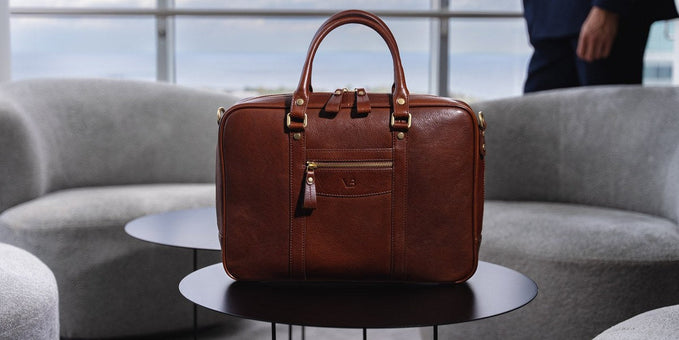
Image: 10X Leather Laptop Travel Bag
Carry it on. A checked bag is a risk you don't take with the one outfit you actually need, and a gate-check puts your bag in the cargo hold with no warning at all.
If your suit and your deck are down there and that bag misses the connection, there's nothing you can do about it before the meeting.
Staying in the cabin means meeting two limits, size and weight. Most US carriers allow a carry-on of around 22 by 14 by 9 inches (56 by 35 by 23 cm).
Plenty of stricter international and low-cost carriers also cap the carry-on at roughly 7 to 10 kg (15 to 22 lb), so check the weight as well as the size before you fly.
A leather carry-on can weigh close to 4 kg (9 lb) before you've packed a sock, which eats into that weight allowance and, on a full flight, gets you waved over to check it at the gate.
If you're not sure which of the carry-on and personal-item categories your bag falls into, we break them down here.
What to pack for the pitch: deck, tech and backups
You can't rehearse the client's meeting room. You see their screen, their cable and their guest wifi for the first time standing in front of the people you're pitching. So pack for that:
- The deck, in three places that can't all fail together: on the laptop, on a USB drive and in the cloud, with a PDF on your phone as the fallback.
- Your own HDMI and USB-C adapters. The room's own adapter is missing as often as it's there.
- Printed copies of the deck and the leave-behinds, a few over your headcount. Extra people often wander into a pitch and sit down.
- A power bank, with everything else charged the night before.
If you want a sane way to lay all this out so you're not digging through it at the front desk, we cover packing a work bag here.
Where should your bag go during the pitch?

Leave the bag, and your coat, out of the room. Not by your chair if you can help it, and never wheel it up to the table.
If you wheel a roller bag in, you spend the first two minutes of the meeting wrestling it into a corner.
Leave the bag at the hotel before you head over, or hand it to the building's front desk or a concierge on the way in.
Walk in with only what you need in the room: the folder, a slim bag, a notebook, your laptop.
And if you've already checked out and there's nowhere to drop the bag, a slim bag you can keep beside your chair still beats a carry-on roller bag you'll be working around for an hour.
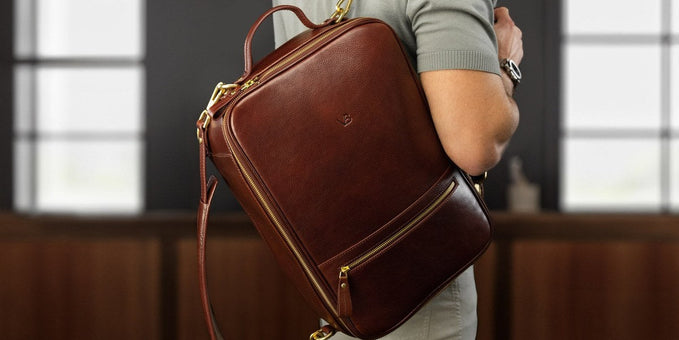
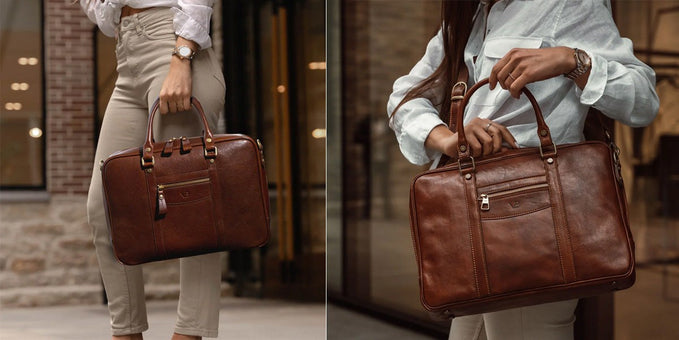
If you are going to bring it to the meeting, make sure it's professional enough to support your appearance in front of the client - no nylon, no canvas, no old scuff marks. We recommend full-grain leather only.
How early should you arrive for a client pitch?
Arrive at the client's front desk 10 to 15 minutes before the meeting.
Show up half an hour early and you become the host's problem before the meeting starts: they get pulled out of their previous meeting, or you sit in view while they scramble to fit you in.
If you land in the area sooner, don't spend the wait in their lobby. Find a coffee shop or a quiet bench, and use the time:
- A last read of your notes.
- A stop in the restroom to check your collar and tie.
- Phone on silent.
Then walk the last block without rushing.
If you're putting together a setup you can reuse for every trip like this, we make a collection of business travel bags you can browse here.

Author: Igor Monte
Igor Monte is the co-founder of Von Baer. He's an expert in all things premium leather, from being an end-user right up to the design and manufacturing process. His inside knowledge will help you choose the best leather product for you.
We strive for the highest editorial standards, and to only publish accurate information on our website.
Related Articles



Leave a Comment
Your email address will not be published.