
Briefcase Weight: What to Think About

The real question isn't "how much" - it's "how much matters"
Most people shopping for a briefcase check dimensions, compartments, maybe the laptop sleeve size. Briefcase weight barely gets a glance.
Then you carry the thing for six months. That slow-building shoulder fatigue on the walk from the station. The ache that sets in somewhere around terminal three. The moment you set it down and feel genuine relief - that's your bag telling you something.
Briefcase weight isn't a spec you optimise once. It's a daily feeling that compounds.
Here's what contributes and how to choose the right briefcase you can carry comfortably:
How much does a typical briefcase actually weigh?
Most professional briefcases fall between 0.8 kg and 2.5 kg (1.8-5.5 lb) empty. That's a big range - the difference between forgetting your bag is there and constantly shifting it between hands.
Here's a rough breakdown by material:
| Material | Typical empty weight | Why |
|---|---|---|
| Nylon / ballistic nylon | 0.8-1.2 kg (1.8-2.6 lb) | Lightest option. Thin, flexible fabric with minimal hardware. |
| Canvas / waxed cotton | 1.0-1.5 kg (2.2-3.3 lb) | Heavier weave, often with leather trim adding weight. |
| Full-grain leather | 1.1-2.0 kg (2.4-4.4 lb) | Leather thickness (1.0-1.8 mm) and hardware quality drive the range. |
| Hard-shell / aluminium frame | 1.8-2.5 kg (4.0-5.5 lb) | Rigid structure adds significant weight. |
Notice the overlap. A well-designed leather briefcase can weigh less than a poorly constructed canvas one. Material matters, but construction matters more.
Interested in a quality briefcase? Discover Von Baer here.
What actually determines briefcase weight

Leather thickness
This is the single biggest weight variable in a leather briefcase. Full-grain leather typically ranges from 1.0 mm to 1.8 mm. Sounds like nothing - but spread across the entire surface area of a bag, even 0.3 mm adds noticeable grams.
Thicker isn't automatically better. Leather cut from the bend at 1.4 mm can outlast belly leather at 1.8 mm - because where the hide is cut from affects fiber density and long-term integrity, not just the thickness number on a spec sheet. In our experience, the thickness that matters is the one that serves the bag's structure without adding dead weight.
Hardware

Solid brass locks, buckles and zippers weigh more than zinc alloy or plastic alternatives. Noticeably more. A pair of solid brass turn-locks can add 80-120 g over their plated-zinc equivalents.
Here's the trade-off worth understanding: if you choose brass hardware, you're carrying more weight today - but brass doesn't corrode, and plated finishes chip. Quality zippers like are cycle-tested into the tens of thousands of pulls. Cheaper alternatives fail far sooner, and when the hardware goes, the bag goes with it. The weight penalty of quality hardware is a one-time cost. The weight penalty of replacing a cheap bag every 18 months is worse.
Lining material

This one surprises people. A synthetic polyester lining is lighter than a cotton canvas lining - sometimes by 100-150 g across the whole bag.
But synthetic linings trap moisture, develop odour faster and don't breathe. We've found that cotton canvas absorbs minor impacts better, protects your laptop screen from hardware pressure points and ages without that plasticky deterioration you see in polyester after a year or two.
Weight isn't always the right thing to minimise.
Structure and reinforcement
Briefcases that hold their shape when empty have internal stiffeners - foam panels, leather-covered boards or moulded inserts. These add 100-300 g depending on how much structure the design provides.
Unstructured briefcases are lighter. They're also the bags that sag, slouch and crease awkwardly under one arm. If you're carrying a laptop, some structure isn't optional - it's protecting a device that costs twenty times what you paid for the lining.
Compartment count and padding
Every additional compartment means more material: dividers, extra lining, stitching reinforcement, sometimes additional zippers. A three-gusset briefcase will always weigh more than a single-compartment design.
But here's what we keep coming back to: if a dedicated padded laptop sleeve means you stop carrying a separate sleeve inside your bag (which plenty of people do), the net weight in your daily carry might actually go down.
The compartments earn their weight by making other accessories redundant.
The weight you carry vs the weight of the bag

Here's the thing no one talks about: your briefcase's empty weight is maybe 15-25% of what you actually carry. A typical daily load looks something like this:
| Item | Approximate weight |
|---|---|
| Laptop (13-16") | 1.2-2.3 kg (2.6-5.1 lb) |
| Charger + cables | 0.3-0.5 kg (0.7-1.1 lb) |
| Notebook / documents | 0.2-0.5 kg (0.4-1.1 lb) |
| Phone, wallet, keys | 0.3 kg (0.7 lb) |
| Water bottle | 0.5-1.0 kg (1.1-2.2 lb) |
Total daily carry: roughly 2.5-4.6 kg (5.5-10.1 lb) of contents. Add your briefcase's empty weight and you're looking at 3.5-7.0 kg (7.7-15.4 lb) on one shoulder or in one hand.
That 300 g difference between a nylon bag and a leather one? Your laptop alone outweighs it several times over. The real weight optimisation is in what you pack, not what you pack it in.
When weight genuinely matters (and when it doesn't)
Weight is a real factor if:
- You walk more than 15-20 minutes with your bag daily - if you're commuting by train or crossing a large campus, cumulative shoulder load adds up over months. That's where material choice starts to matter.
- You have a shoulder, back or neck condition - even 200 g makes a difference when you're managing pain. Go as light as your other requirements allow.
- Your briefcase is your airline personal item - most airlines allow 7-10 kg for personal items. If you're a carry-on-only traveller, every gram of bag weight is a gram less of stuff you can bring. (We cover the travel angle in more detail in our best travel briefcases roundup.)
Weight matters less than you'd think if:
- Your briefcase goes from car to desk - if you carry it for 60 seconds twice a day, the weight difference between materials is genuinely irrelevant. Spend your decision budget on build quality instead.
- You're comparing within the same material - the difference between a 1.3 kg leather briefcase and a 1.5 kg one is 200 g. You won't feel it.
- You're trading durability for lightness - a bag that's 400 g lighter but doesn't protect your laptop properly isn't saving you anything. It's a false economy that catches up with you.
A simple framework for deciding
- What's your daily carry distance? Under 10 minutes of walking? Weight is nearly irrelevant - prioritise materials and build quality. Over 20 minutes? Weight becomes a genuine selection factor.
- What's your daily load? If you carry a 2 kg laptop plus charger, your contents already weigh 2.5+ kg. The bag's contribution to total weight is proportionally small - you'll get more relief from a lighter laptop than a lighter bag.
- What are you willing to trade? Lighter bags typically mean thinner leather, synthetic linings, lighter-weight hardware or less structure. Some of those trade-offs are fine. Some aren't. (If you want to understand how different briefcase materials affect more than just weight, we break that down separately.)
What about leather briefcases specifically?

Leather briefcases sit in the 1.1-2.0 kg range empty. Within that range, the key variables are leather thickness, hardware material and how much internal structure the bag provides.
A slim, single-compartment leather briefcase with minimal hardware can come in around 1.1 kg - light enough that most people wouldn't distinguish it from a nylon alternative by feel. A triple-gusset, fully structured briefcase with solid brass locks will push toward 1.8-2.0 kg.
Both are good bags. They're just built for different carrying patterns. (If you're deciding between styles, our breakdown of briefcase types covers the practical differences.)
One thing worth knowing: vegetable-tanned leather tends to be marginally denser than chrome-tanned leather at the same thickness. The difference is small - maybe 5-8% - but it exists. It's one of the trade-offs of a tanning process that produces leather with better aging characteristics and develops a richer patina over time. If you're choosing between the two and weight is a concern, this is a factor - though for most people it's not a deciding one.
The shoulder strap question
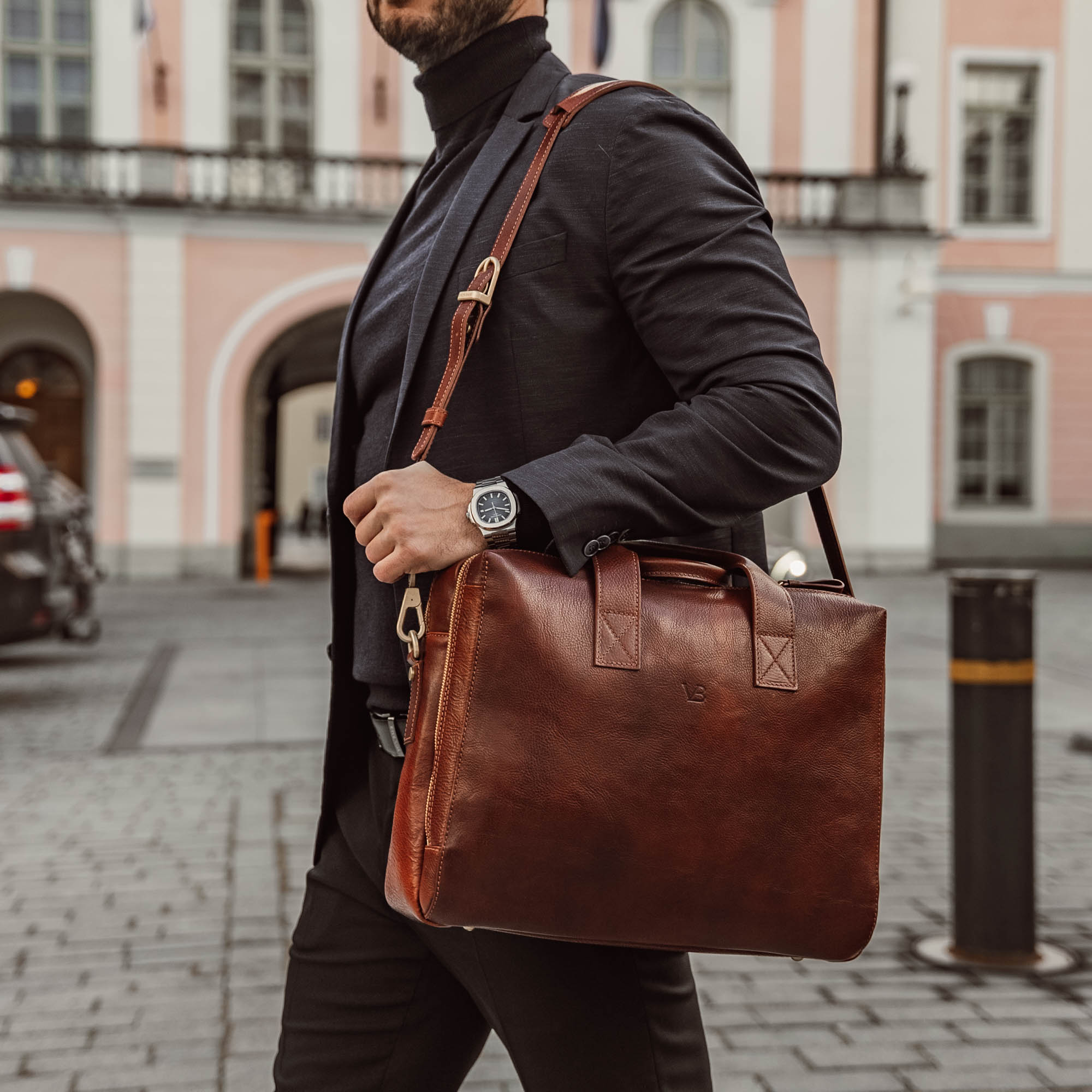
A detachable shoulder strap adds 150-250 g to your briefcase. That's a real addition.
But distributing weight across your shoulder via a strap is dramatically more comfortable than carrying the same weight by hand. A 1.4 kg briefcase on a shoulder strap feels lighter than a 1.1 kg briefcase carried by hand over the same distance. Perceived weight depends on load distribution, not just grams.
If you're concerned about weight because of comfort, the strap might solve your problem entirely - even though it technically makes the bag heavier. (There's more to the carrying decision than weight alone - we cover the ergonomics in our post on how to carry your briefcase.)
Bottom line
Briefcase weight is worth thinking about. It's not worth obsessing over.
The differences between materials are real but moderate. The differences between carrying habits - how far you walk, how you distribute the load, what you pack inside - matter more. And the durability trade-offs of chasing minimum weight can cost you more in the long run than the grams you save.
If you're walking long distances daily, prioritise a slim design with a good shoulder strap over raw lightness. If your carry distance is short, spend your decision-making budget on materials and build quality instead. The weight will sort itself out.

Author: Igor Monte
Igor Monte is the co-founder of Von Baer. He's an expert in all things premium leather, from being an end-user right up to the design and manufacturing process. His inside knowledge will help you choose the best leather product for you.
We strive for the highest editorial standards, and to only publish accurate information on our website.
Related Articles



Leave a Comment
Your email address will not be published.